

The computer of tomorrow is very small
You already hold it in the hand and it can connect to any peripheral...
A benchmark published by OpenBenchmarking.org shows that the power of the best mobile processors (in this case the Tegra X1) is equivalent to that of a low-end desktop:
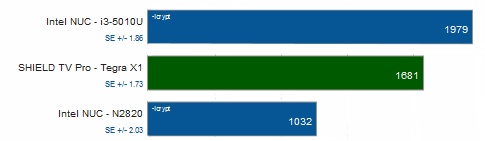
For most users, especially those of the Internet, the increasing power of mobile units is becoming sufficient to render the PC useless. The computer is now a smartphone or tablet and using a dock it connects to a large screen and other devices usually connected to a PC.
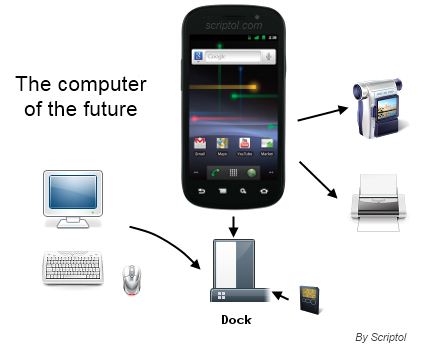
As shown in the diagram, we will use a large screen, keyboard and mouse to work comfortably. The cell phone connects wirelessly to a camera or video recorder according to a Wi-Fi or Bluetooth protocol. You can also print directly throughta wireless transmission, that printers already have.
The storage will be provided by a hard disk connected to the dock or memory cards directly inserted into it.
Motorola Atrix
It is already developing this concept in two directions: the first corresponds to the diagram above, the second is to plug a smartphone into a notebook with a keyboard and screen, but devoid of CPU and memory.
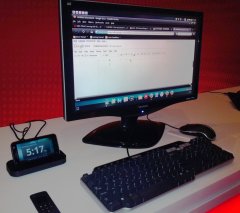
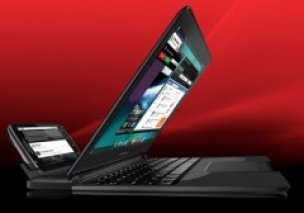
The notebook in turn can be connected to all devices of a PC ...
This model is equipped with Android but when it is inserted into a dock, it loads the WebTop environment more suitable for local use.
This gives access to the file system and includes the Nautilus file manager for Linux. Other Linux software are also added.
The PC are just becoming machines dedicated to gamers, graphic designers and developers ... which will connect to the same dock as the smartphone!
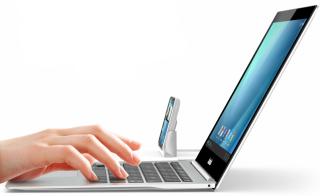
The clambook
This is a stylish keypad and display handset with a dock to connect your smarphone and turn it into a PC, as does the Atrix, with more versatility as it works with an Android device or iPhone.
It has its own battery to power the screen, but has a limitation: only running in landscape mode (and not in portrait mode), it does not take advantage of all the applications available on mobiles. Its interest, however, is obvious to common activities such as sending email, web-browsing for connected mobiles. When this will be the case to all smartphones and they will have more power, this will be the computer of tomorrow for most users.
The Chromebook
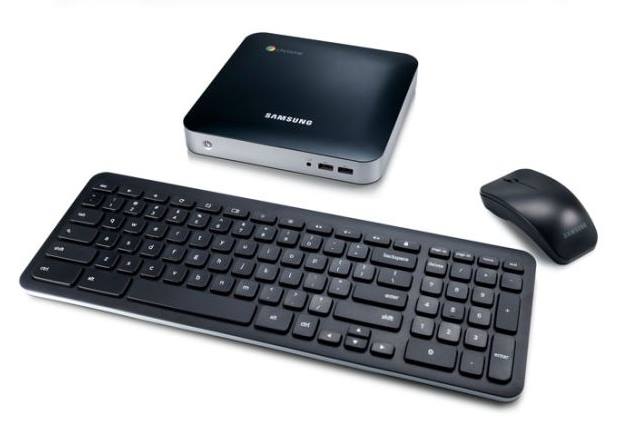
We see its image on the right. This is not the computer of the future, since it is quite current, but it seems to prefigure it (DVI port apart!).
It perfectly meets our expectation of a full computer, powerful enough, but also ultra-compact.
It works with the Chrome OS of Google, in other works using mainly web applications (online or offline), but the Aura interface might make it closer to a more conventional machines.
And it costs only $ 300!
Soon the Smartbook
This is a term coined by the founder Qualcomm. To allow manufacturing ultra-light laptops, much more than ultrabooks, or the Mac Air, it finalizes the design of an ARM processor with four cores, powerful enough to run Windows 8. The Snapdragon S4 will replace Intel processors, a revolution in the world of laptops!
The processor contains a chipset sufficient for HD video and a modem. It will run games on Windows 8.
The next step would be to move to a ultra-compact version of PC with an ARM processor. If the mobile has not already replaced it...
A video projector to replace the monitor
It's not foresight, but already a reality. Galaxy Beam models of Samsung are equipped with a pico projector with an output of 15 lumens and can display an image of 50 inches.
This does not really allows making graphics on a big screen but is suitable for watch videos or games. The videos that can be seen on Youtube shows a somewhat blurred image. To get an image similar to that of a movie theater, 2000 lumens would be needed, and this permits larger dimensions. Business projectors do not have a resolution greater than that of a smarphone, they just offer a larger and better image.
Documents
- Rasperry Pi is a mini-motherboard costing $ 25, with an ARM processor, that can display videos in 1080p or play Quake III (video).